Hit
Ask the dealer for another card. You hit when your total is low enough that one more card is more likely to help than to bust you.
💡 Hand signal: tap the table.Hit, stand, soft 17, DAS, true count… blackjack has its own language, and knowing it is the difference between guessing and playing basic strategy. Every term below is explained in plain English with the strategic takeaway, written by the editors behind our blackjack calculator.

The decisions you make on every hand.
Ask the dealer for another card. You hit when your total is low enough that one more card is more likely to help than to bust you.
💡 Hand signal: tap the table.Keep your current total and end your turn. You stand when you are happy with your hand or when the dealer's upcard suggests they are likely to bust.
💡 Hand signal: wave your hand flat over the cards.Double your original bet after seeing your first two cards and receive exactly one more card. Basic strategy doubles on hard 11 against almost everything and on hard 10 against a dealer 2 to 9.
💡 Best with 9, 10 or 11.When your first two cards share the same value, separate them into two hands, each with a bet equal to the original. Always split aces and 8s; never split 10s or 5s.
💡 Re-split rules vary by table.Give up your hand after the initial deal and get half your bet back. "Late surrender" is only offered after the dealer checks for blackjack. Correct on hard 16 vs a dealer 9, 10 or ace, and hard 15 vs 10.
💡 Not offered at every table.A side bet of up to half your stake, offered when the dealer shows an ace, paying 2:1 if the dealer has blackjack. The house edge is around 7%, so basic strategy says never take it.
💡 Also sold as "even money" on your own blackjack.When you hold a blackjack and the dealer shows an ace, the dealer may offer to pay you 1:1 immediately instead of risking a push. Mathematically identical to taking insurance: decline it.

What your cards add up to and how the round ends.
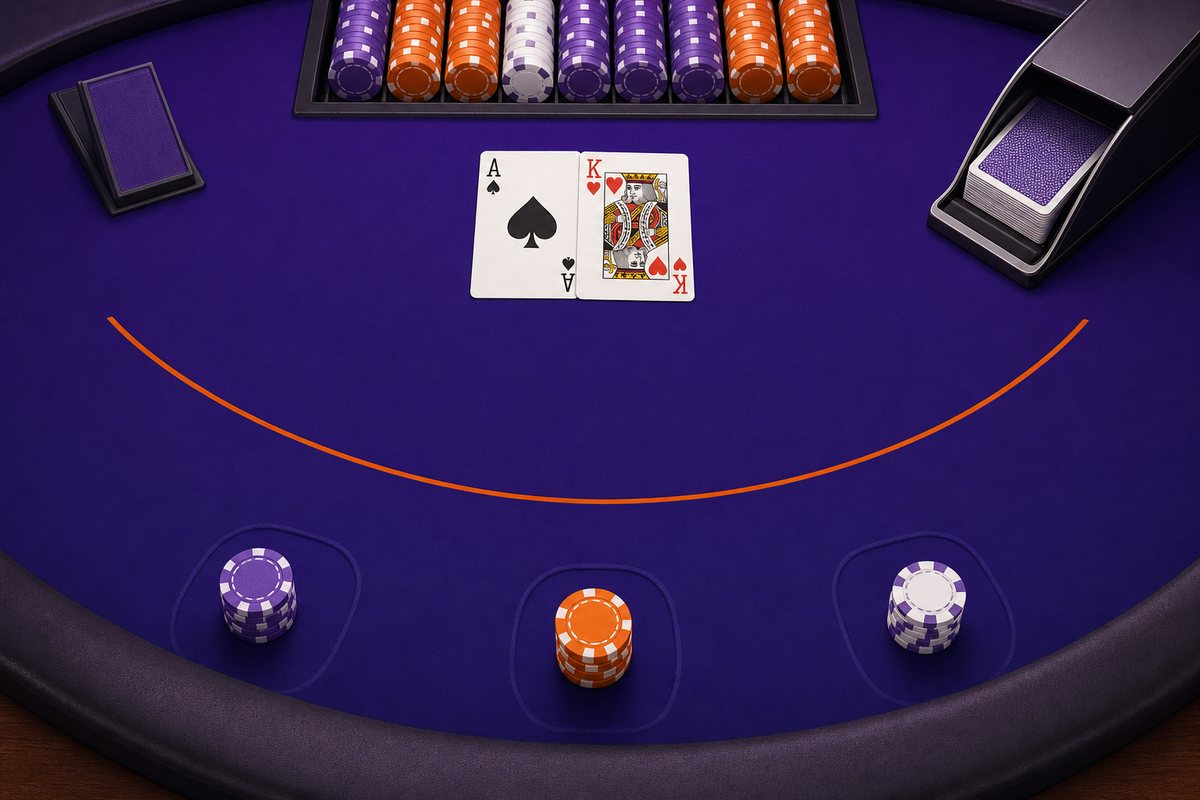
An ace plus a 10-value card as your first two cards. It beats any other 21 and pays 3:2 at a fair table. Tables paying 6:5 raise the house edge by about 1.4%: avoid them.
💡 Look for "Blackjack pays 3 to 2" on the felt.A hand containing an ace counted as 11, such as A-6 (soft 17). You cannot bust a soft hand with one card, which is why basic strategy hits and doubles soft hands more aggressively.
A hand with no ace, or where the ace must count as 1 to stay under 21. Hard 12 to 16 are the "stiff" hands where most of the difficult decisions happen.
Going over 21. A busted player loses immediately, even if the dealer later busts too, which is the main source of the house edge.
A tie between your total and the dealer's. Your bet is returned. A dealer blackjack pushes against a player blackjack.
A hard total of 12 to 16: not good enough to stand confidently, but a hit risks a bust. Strategy depends entirely on the dealer's upcard.
A hard total of 17 or more. You stand on every pat hand.

The rules printed on the felt that decide the house edge.
The dealer's face-up card. Every basic strategy decision is made by comparing your hand to this card. A 2 to 6 is a "weak" upcard, a 7 to ace is "strong".
The dealer's face-down card. In US-style games the dealer checks it ("peeks") for blackjack when showing an ace or 10; in European "no hole card" games the dealer draws it after players act.
Whether the dealer Stands or Hits on soft 17. S17 is better for the player; H17 adds roughly 0.2% to the house edge.
💡 Printed on the table layout.Double After Split: being allowed to double down on a hand you created by splitting. Lowers the house edge by about 0.14%.
Re-Split Aces: being allowed to split aces again if you draw another ace. A small but real player-friendly rule.
The casino's long-run advantage. With perfect basic strategy at a 3:2, S17, DAS table it is around 0.5%, one of the lowest in the casino. Use our blackjack calculator to see the edge for any rule set.
The box that holds and deals the cards, usually 6 or 8 decks. Fewer decks are better for the player.
How deep into the shoe the dealer goes before shuffling. Deep penetration matters to card counters; casual players can ignore it.
The first card of a new shoe, discarded face-down before play begins.
The coloured plastic card placed in the shoe that marks where the dealer will shuffle.

Terms you will meet in strategy guides and at the cashier.
The mathematically optimal decision for every player hand against every dealer upcard, usually shown as a colour chart. Playing it perfectly cuts the house edge to about 0.5%.
💡 Our calculator gives the exact move.Tracking the ratio of high to low cards left in the shoe and raising bets when the shoe is rich in 10s and aces. Legal, but casinos may ask counters to leave; impossible online with continuous shufflers.
In the Hi-Lo system, +1 for cards 2 to 6 and -1 for 10s and aces gives the running count; dividing by decks remaining gives the true count used for bet sizing.
Optional extra wagers such as Perfect Pairs or 21+3. Fun, but house edges run from 3% to over 10%.
The casino token that represents money. Colour denominations vary by casino; online, chips are just a visual for your balance.
A tip for the dealer, often placed as a bet on the dealer's behalf.
The money you set aside for play. A common guideline is at least 50 to 100 base bets for a session.
No term matches your search.

Casinos with 3:2 blackjack tables, tested by our editors · 18+ · T&Cs apply